home featured
Follow the Vine Trail
The recently debuted extension between St. Helena and Calistoga marks notable progress toward the dream of 47 miles.
WRITTEN BY Jillian Dara
|
Published On: November 17, 2025

Photo above courtesy of Napa Valley Bike Tours
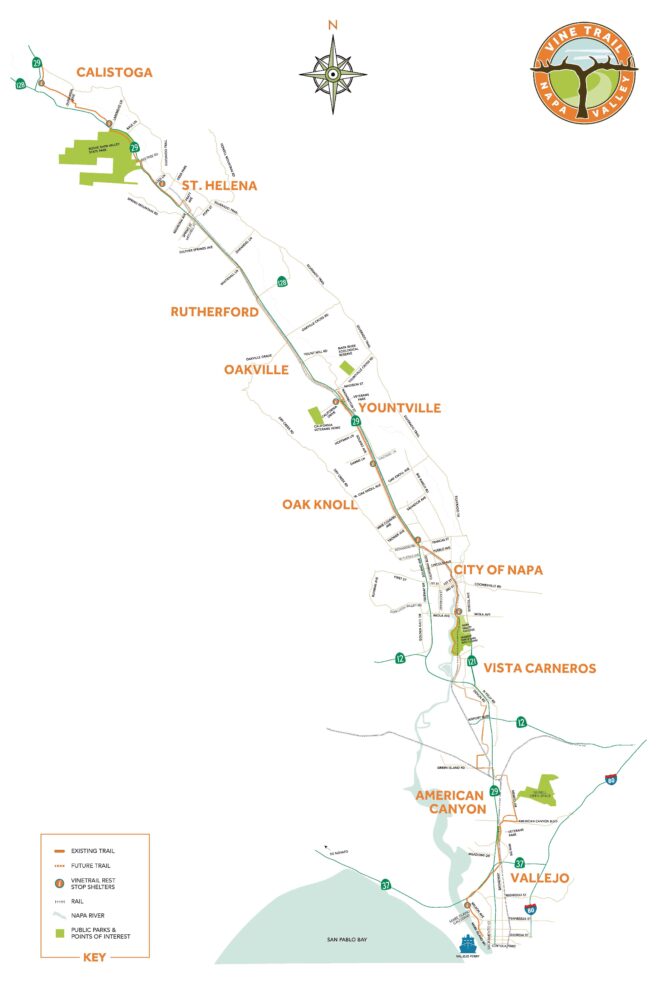
The Napa Valley Vine Trail Coalition is inching closer to their end goal of a 47-mile walking and biking trail that will meet their mission to “connect the entire Napa Valley—physically, artistically and culturally.”
“Today, there are 33 completed miles in three major sections used by 396,000 people annually,” shared Shawn Casey-White, executive director of the Napa Valley Vine Trail Coalition. There are 14 miles remaining to complete the dream of 47 miles—separate from cars—connecting Vallejo all the way to Calistoga along the main transportation artery of Highway 29.
Photo courtesy of Napa Valley Bike Tours
As the Coalition looks toward the future, they’re also reflecting on how far they’ve come in less than two decades. The concept for the Vine Trail was the vision of the late wine industry executive Tom Shelton, who wished he could teach his children to ride their bikes on a safer route. At his celebration of life in 2008, the first $50,000 was raised to explore the feasibility of creating a bike route through the Napa Valley, and in 2009, the first phase of the trail debuted as the Yountville Mile Bike Lane.
“The Vine Trail is collaboration in action,” said Casey-White, explaining how the Coalition works with every jurisdiction in the county—from American Canyon to the transportation authorities in Solano—as well as private landowners in Napa Valley who have donated easements to make the trail possible. “It’s an example of a successful private-public project that leverages private philanthropy and community support to unlock and secure federal and state transportation and safety grants set aside for projects exactly like this one.”
While the Vine Trail has served as an asset to the local community—increasing bike and pedestrian safety, providing alternative transportation choices, shifting cars off the highway, and reducing air pollution—Casey-White says her favorite part about the Vine Trail is how it connects people in general, both the local community and visitors.
“Out on the Vine Trail, you might meet a teacher training for a marathon, a world-famous winemaker out on a bike ride with his or her family, a Vallejo resident riding to work in Napa (the trail offers access to jobs at over 1,600 locations within half a mile along its corridor), a mom walking to the Farmers Market, a senior going to a doctor’s appointment, a formerly wheelchair-bound resident on his recumbent bike, an international visitor soaking in the Napa Valley, or even our very own U.S. Congressman Thompson out getting some exercise,” she says.
For those unfamiliar with the trail, Casey-White likes to suggest picking one of the three main sections of the trail for a leisurely bike ride or walk “to get to know the trail” better. “It’s your Vine Trail,” she prefaced. If she had to choose a couple of her favorite routes, they’d be a longer ride along the 16-mile loop between St. Helena and Calistoga or a casual two-mile stroll from Bothe-Napa Valley State Park to Larkmead Vineyards. “You can leisurely walk along the vineyards through Twomey and Sterling Vineyards,” she added.

Photo courtesy of Napa Valley Bike Tours
For further inspiration, Casey-White suggested: “Ride your bike from American Canyon High School to the Vallejo Ferry next time you go to the SF Giants game.” Or rediscover the Rail-Arts District of Napa, a free outdoor contemporary art museum between Vallejo and Jefferson, then loop back for smoked brisket at Stateline Road Smokehouse. “Each section allows you to slow down and enjoy our valley at ground level,” said Casey-White.
Quick Top Five
For visitors strapped for time, Casey-White summarized her top five highlights on where to stop along the Vine Trail, whether seeking exercise in between wine tastings or using the trail to connect vineyard experiences.
1. From St. Helena to Calistoga, you’ll ride through Bothe-Napa Valley State Park, a shaded respite with hiking trails, a welcoming picnic area, and even a spring-fed public swimming pool.
2. The Napa Valley Vintners created two one-mile walking routes to visit three wineries along the trail. The first route connects three famed St. Helena wineries: Charles Krug Winery, Ballentine Vineyards, and Markham Vineyards. The participating wineries all donated precious land to make this possible for visitors and locals alike.
3. You can rent a bike from Napa ValleyBike Tours at Charles Krug Winery. When you return, you can have one of their brick oven pizzas and a splash of Napa Valley wine.
4. Enjoy the urban art pieces along the trail from the Vallejo Ferry and look out for the ‘Trolls Under the Bridge,’ an artwork created by Vallejo artist Miro Salazar, displayed on the support beams beneath the Mare Island Causeway Bridge.
5. Ride a bike to the section of the Vine Trail that runs from Vallejo Street to Lincoln Avenue to view the newly displayed Quake Mosaic, a large-scale public artwork by Kristina Young. Over the past decade, Young collaborated with more than 2,000 community members to transform tons of broken household objects—donated after the 2014 earthquake and two devastating wildfires in 2017 and 2020—into a massive mosaic inspired by underground geological strata.