
home featured + Travel
A Journey to Georgia
The Cradle of Wine
WRITTEN BY Layne Randolph
|
Published On: July 21, 2025


Pictured Above: Kartlis Deda // Photo by M Claushallmann
Kartlis Deda (Mother of Georgia) stands tall over Tbilisi, her imposing statue sending what some might call a dual message. In one hand, she grips a mighty sword, ready to defend against foes; in the other, she offers a bowl of wine, symbolizing the warmth of Georgian hospitality. In this land steeped in legend and history, both objects have served their purpose—but in modern times, the bowl of wine rules.
Widely known for its ancient winemaking traditions, Georgia is often considered wine’s birthplace. Though many places claim this title, scientists have confirmed that wine residue on pieces of pottery discovered in Georgia dates back over 8,000 years—evidence of grape cultivation and fermentation in the region for millennia.
Georgia, once a Soviet republic until it claimed sovereignty in 1991, sits at the crossroads of Eastern Europe and Western Asia. Powerful neighbors frame it—Russia to the north, Turkey to the southwest, Armenia and Azerbaijan to the south, and the Black Sea to the west.
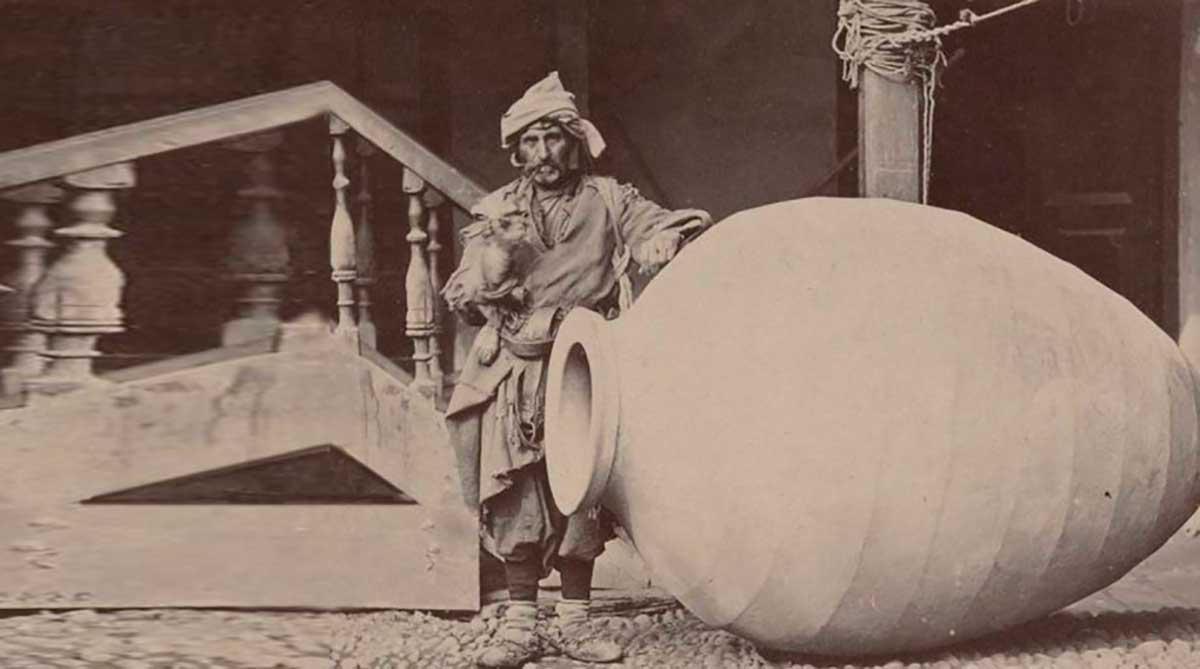
Historic image provided by WineCast
Georgia’s Traditional Winemaking in Qvevri
To introduce current visitors to Georgia’s modern influence, the WineCast Wine and Film Festival recently held its opening inside Tbilisi’s Wine Museum. The WineCast Festival is a celebration of both wine and film cultures. It started with a screening of the black-and-white film Kvevri, based on the novel The Oil Plot by Nobel Prize-winning author Luigi Pirandello. The comedic movie tells the story of a man building a qvevri (modern spelling) who accidentally closes himself into it and can’t escape through the small opening. Rusudan Tchumbadze, WineCast Co-Founder and CEO of the Tbilisi Wine Museum, described the classic film as embodying “the essence of Georgian culture– that celebrates wine and its deep roots in Georgian tradition.”
The qvevri lies at the heart of Georgia’s ancient winemaking tradition. The large egg-shaped clay fermentation tank holds grapes, skins, and stems to ferment and age for months. Buried below the earth, the vessels naturally maintain a stable, cool temperature, revealing the brilliance of Georgian winemaking long before modern tools existed.
After the wine is transferred into barrels or bottles, a (hopefully) smallish human squeezes into the underground vessel to clean the inside with an arched tool of twigs called a tagvisara. The tagvisara removes residue from the sides before the person inside coats the interior with beeswax to reseal the vessel.
It’s not the easiest way to make wine, but Georgians feel traditional qvevri winemaking is the only way to taste the true terroir and variety.
“I don’t like factory wine,” said Guram Alapishvili, a Georgian Mountain Guides Association trekking guide. “It’s not our wine.” When pressed for the definition of “factory wine,” he replied, “filtered”—shorthand for the commercial style used elsewhere in the world and even in parts of Georgia today. “Their wine” is the traditional qvevri method that UNESCO recognizes as an intangible cultural heritage, symbolizing how deeply this practice is woven into the fabric of Georgian life.
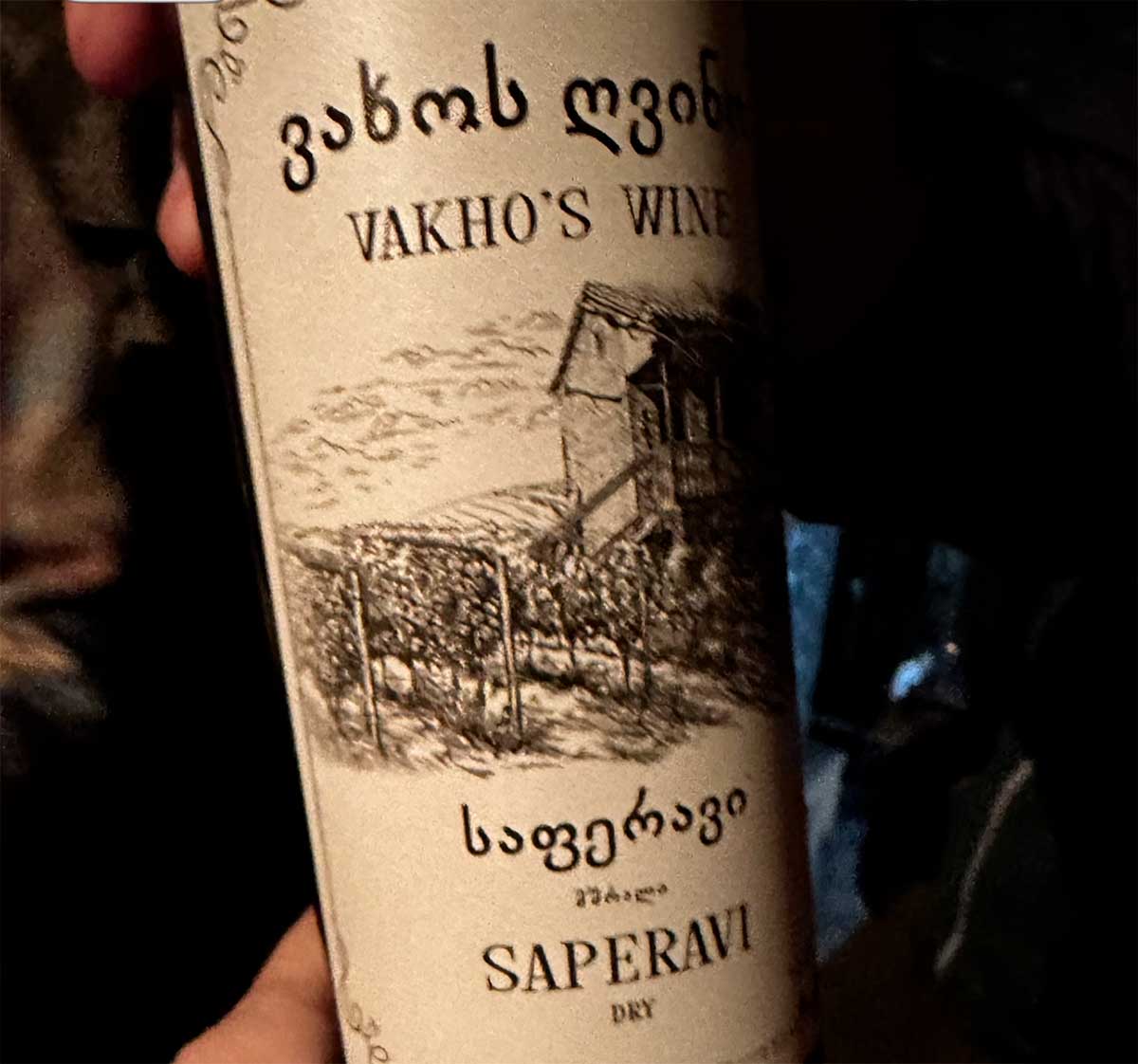
Vakho’s Wine Saperavi // Photo by Layne Randolph
Kakheti Wine Region and Producers
Although Kakheti is only one of the country’s wine regions, it is the epicenter of its winemaking heritage. Located along the Caucasus Mountains in eastern Georgia, Kakheti produces three-fourths of Georgia’s over 500 indigenous grape varieties. The country’s vineyards include endangered vines found nowhere else on earth.
The fertile region’s continental climate and sandy, red, calcareous clay soils produce mainly white grapes—75 percent of Kakheti’s production—used for amber wine, created by allowing the white grapes an extended time on their skins.
Commonly called orange wine in the U.S., these dark-gold wines have a fuller, more tannic body than white wines made using modern methods. They also have deep, earthy flavors that one might mistake for red wine if not for their appearance.
Take the 2020 Kardanakhi 1888 Estate Rkatsiteli Tsarapi, which won a Gold Medal in the 2024 International Wine and Spirits Competition, scoring 97 out of 100. It received praise for “golden raisins and freshly baked pastries on the nose” and a “velvet palate with a complex yet silky structure.” It was fermented and aged on skins in qvevri for six months.
Shumi Winery is a Kakheti producer and preservationist with hundreds of varieties in its vineyards. Shumi’s name comes from the ancient Georgian word for undiluted wine, and the winery’s griffin logo is based on a mythical creature, Phaskunji, who gave the first bunch of grapes to the world.
Shumi’s Uberiuli Ubakluri Qvevri Amber is a prime example of traditional qvevri wine: bold, tannic, and redolent of dried fruit and spice. But Shumi is also forward-looking, crafting rare sparkling wines like Shobili Begotten Brut Nature.
Shumi’s vineyards include grape varieties that were once considered lost during the Soviet occupation when Georgians were forced to remove indigenous vines and replace them with international varieties for mass production. Post-independence, Shumi’s owner began recovering vines and seeds still growing in Georgian backyards. Hundreds have undergone DNA testing and been replanted—even those that can’t be matched to any known variety.
Through this type of wine history preservation, the country not only maintains its title as the Cradle of Wine but also solidifies its importance today and in the future.
Rkatsiteli is one of the country’s most popular and versatile white grapes. It produces crisp, light wines or rich, full-bodied ones, depending on the production method. Mtsvane is another sought-after variety known for elegant, aromatic wines with floral and fruity notes. The 2021 Château Mukhrani Goruli Mtsvane blends 85% Goruli Mtsvane and 15% Chinuri for a wine with pronounced minerality, stone fruit, and a green apple and pear bouquet.
And the country’s winemakers aren’t resting on their laurels with their fascinating history; they are reinterpreting the heritage, blending ancient methods with contemporary techniques. One example is Pat’ra Marani’s Kisi (Qisi Qvevri), fermented in qvevri with skins but no stems for four months, then aged in qvevri without skins or stems for ten more months before being filtered.
The 2019 Telavi Old Cellar’s Archil’s Wine Saperavi showcases Georgia’s most famous red grape, full-bodied with bold flavors and high tannin content. It’s traditionally made using skins and stems but aged in French oak, exemplifying the practice of blending past and present.
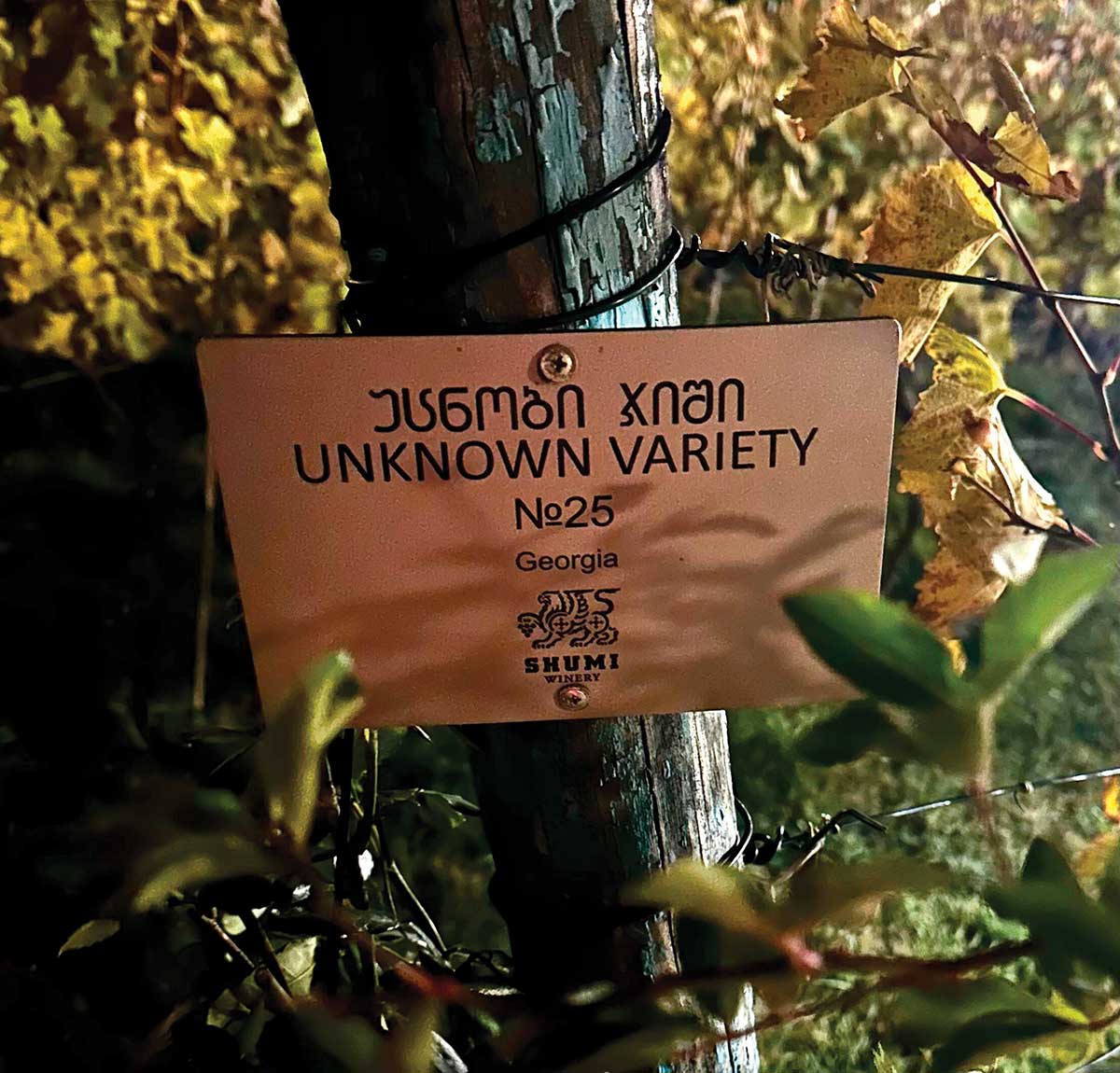
An unknown variety in the Shumi vineyard // Photo by Layne Randolph
A Country on the Rise
Whatever they are doing, they’re doing it right. According to Georgia Today, in 2024, Georgia exported a record-breaking $565 million in wine and spirits. That included 95 million liters of wine shipped to 72 countries, with wine alone accounting for $276.1 million. But Georgia’s rise isn’t just in numbers—the wine scene feels alive, too. Grape varieties thought to be lost are coming back. Young winemakers are mixing ancient methods with bold ideas. International sommeliers are showing up, wondering why they hadn’t discovered this place sooner.
As seen with the WineCast Festival, Georgia is a destination not just for wine enthusiasts and curious travelers but also for filmmakers searching for the rare and the real. Tamta Gabrichidze, WineCast Co-Founder, Film Director, and Sundance Award-winning filmmaker, said, “You can shoot a film here, enjoy the best wine, and still feel like you’ve discovered something unknown.”
Kartlis Deda’s sword may still be there, but the bowl of wine comes first.
Other Things to Experience Beyond Georgia’s Ancient Wine World
Cuisine
The vibrant wine culture is celebrated throughout the country alongside the rich flavors of Georgian cuisine, where walnuts play a starring role in many traditional dishes. Breakfast might begin with black bread baked with walnuts, and every supra (feast) includes dishes like:
- Pkhali, a vegetable-walnut pâté, served as a condiment or side dish. It consists of chopped and cooked vegetables like spinach or beets with a rich walnut paste seasoned with garlic, herbs, and spices.
- Badrijani Nigvzit, roasted eggplant wrapped around spiced walnut paste.
- Satsivi, chicken, or turkey stewed in a creamy walnut sauce.
As is often the case with food from a wine region, the earthy richness of these dishes pairs beautifully with Georgia’s amber wines.
Cable Car to Narikala Fortress (Tbilisi)
Glide over the city on a scenic gondola ride to the 4th-century Narikala Fortress. Once a strategic defense post, the fortress now offers breathtaking panoramic views of Tbilisi’s red-roofed Old Town, the Kura River, and the eclectic architecture that defines Georgia’s capital.
Mtskheta
Just 20 minutes from Tbilisi lies Mtskheta, one of the oldest continuously inhabited cities in the world and a UNESCO World Heritage Site. Visit the hilltop Jvari Monastery, an early Christian masterpiece overlooking the confluence of rivers, and the Svetitskhoveli Cathedral.
Alaverdi Monastery
The Alaverdi Monastery dates to the 6th century and still houses monks who produce wine using ancient qvevri techniques.